It is 1985. On a cinema screen in West Germany, a working-class American boxer with a thick Philadelphia accent is fighting Ivan Drago, a Soviet super-soldier built by the communist state to be the perfect fighting machine. The audience knows how this ends. They always know how this ends. Rocky wins. America wins. And in cinema lobbies from Frankfurt to Tokyo to Mumbai, a feeling is being quietly deposited in the minds of millions of viewers. America wins. America always wins. This is not news. This is just the movies. But it was never just the movies.
CHAPTER ONE: WORLD WAR II AND THE BIRTH OF PROPAGANDA CINEMA
It started in 1942 when President Franklin D. Roosevelt picked up the phone and called the studios. He understood something most politicians did not. Cinema was not entertainment. It was the most powerful communication tool ever invented. Millions of people, sitting in the dark, emotionally open, with sound and image bypassing their rational mind and going straight to their feelings. Roosevelt wanted that and Hollywood was happy to provide it.
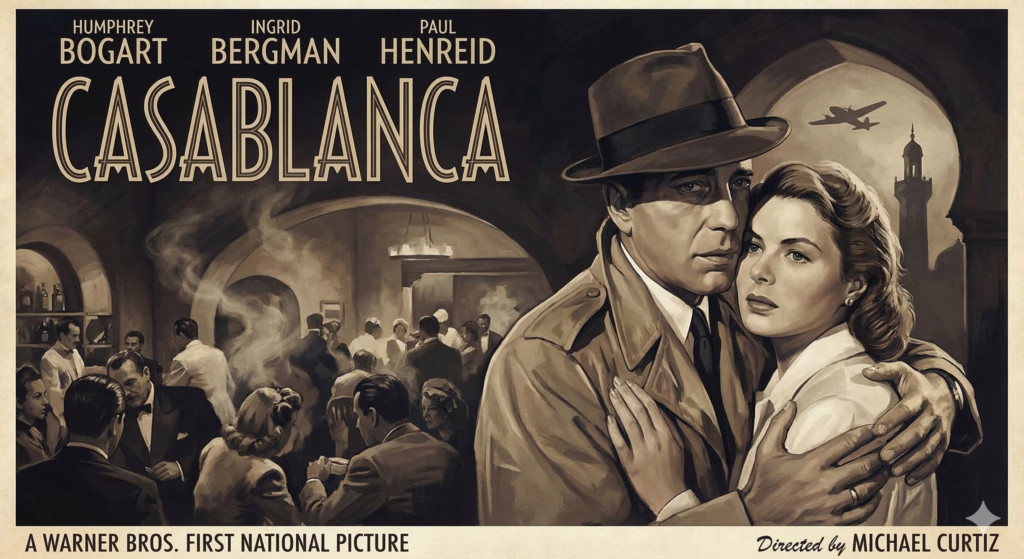
The Office of War Information began reviewing scripts, suggesting changes and steering Hollywood toward stories that served the war effort. What came out of this arrangement was not clumsy propaganda. It was something smarter. Casablanca (1942) is the best example. A love story on the surface. Underneath, a film arguing that neutrality in the face of evil is a moral failure. The politics and the romance were inseparable. That is exactly what made it work.
What most people do not know is that the CIA later took this further. The Congress for Cultural Freedom, which spread Western art and culture across Europe as a counter to Soviet influence, was revealed to have been entirely CIA-funded. America was not just making films. It was funding the whole system that distributed those films internationally as weapons in a war for people’s minds. The Cold War was fought in cinemas. Hollywood was a war zone.
CHAPTER TWO: THE DEAL HOLLYWOOD MADE
The Pentagon has had an official entertainment liaison office since 1947. The arrangement is simple. Filmmakers who want military cooperation, real aircraft carriers, real fighter jets, real soldiers, submit their scripts for review and agree to requested changes. The deal is: you get the hardware, we shape the story.
Top Gun (1986) is the clearest example. The Navy approached the producers directly. Real F-14s and real aircraft carriers appear throughout. In return, Navy aviation recruitment rose sharply and the Navy set up actual recruitment booths in cinema lobbies. When Top Gun: Maverick came out in 2022 and made one and a half billion dollars globally, they did it again.
The scripts that get changed have American soldiers’ crimes removed, dialogue adjusted so American military action always appears justified, and villains’ nationalities switched when the original choice was politically awkward. The CIA ran an identical operation, using films like Argo and Zero Dark Thirty to shape how audiences understood intelligence work. Argo won Best Picture while dramatically erasing Canada’s role in the story it was supposedly telling. Zero Dark Thirty showed torture producing the intelligence that found Bin Laden. The Senate Intelligence Committee later concluded it did not. Millions of people around the world believe the film’s version. That is soft power at its most consequential.
The films the Pentagon refused to cooperate with tell the same story from the other side. Apocalypse Now, Platoon, Full Metal Jacket, Three Kings. Every film on that list is one of the most honest examinations of American military power ever made. Not one of them had a Pentagon helicopter. The contrast makes the argument for you.
CHAPTER THREE: THE NARRATIVES THAT BUILT THE MYTH
The most consistent story in Hollywood history is also the simplest. When the world faces its worst crisis, an American steps forward and solves it. Aliens invade in Independence Day. An American fighter pilot finds the answer. An asteroid threatens all life in Armageddon. American oil drillers stop it. An astronaut is stranded on Mars in The Martian. American NASA brings him home. The pattern never breaks. The global audience absorbed, without being told, a single equation: crisis plus America equals salvation. Delivered as entertainment, it bypassed every critical filter that actual propaganda would have triggered.
The message is not only in the stories. It is built into how the films are made. Fighter jets in Pentagon-cooperated productions are almost always shot from below against a clear blue sky, a camera angle that makes them look enormous and almost beautiful. The sound design is mixed to produce awe before a single line of dialogue is spoken. Compare this to Apocalypse Now, where the same helicopters opening the film to The Doors are filmed as instruments of destruction. The machines are identical. The filming is different. The political effect is opposite.
As military adventurism became harder to celebrate after Iraq and Afghanistan, Hollywood shifted its superpower story from fighter jets to Silicon Valley. The Social Network and Steve Jobs reinforced the idea that world-changing innovation happens in America, through specific American individuals, producing things the whole world then uses. When a teenager in Lagos uses an iPhone and has seen Steve Jobs, they are not just using a device. They are participating in an American story.
CHAPTER FOUR: THE MARVEL UNIVERSE
No cultural phenomenon has spread American mythology more effectively than the Marvel Cinematic Universe. Over thirty billion dollars at the global box office. Films seen in countries openly hostile to American foreign policy, consumed by audiences with radically different values and political systems.
Captain America is the most explicit symbol. Literally named after the country. His shield in red, white and blue is both his weapon and his identity. His origin story is a near-perfect metaphor for how America sees itself: not the strongest by birth, but transformed by values and sacrifice into something exceptional. What is clever is that the films do not pretend the story is simple. The Winter Soldier is explicitly about institutional corruption. And yet its conclusion is always the same: a good American can fix it. The critique is absorbed and converted into a story about American renewal. That is more durable and more exportable than simple flag-waving.
Iron Man appears to critique the military-industrial complex. Tony Stark starts as a weapons dealer whose products kill civilians. He has a moral awakening. But what he becomes is not a pacifist. He becomes a better weapon. Smarter, more precise, more personally accountable. The critique dissolves inside the story that makes American military technology look like the most impressive thing on Earth. The Pentagon cooperated extensively on the sequels. The message they got out of it: American military technology is so advanced it has essentially become superhuman.
CONCLUSION
Hollywood did not make America a superpower. America made Hollywood. The films that projected American power around the world were made by people who genuinely believed in what they were making. The soft power worked not because it was cynically manufactured but because it was authentically felt. The best propaganda always is.
The person in that 1985 West German cinema watching Rocky defeat Ivan Drago was not being manipulated. He was being entertained. He was feeling something real. The fact that what he was feeling had been institutionally supported and commercially distributed across every cinema market on Earth did not make the feeling false. It just made it useful and the world still has not stopped watching.